Wednesday, April 23, 2014

Meteroids, Meteors, and Meteorites


Meteoroids are found in outer space.  They float around randomly, and with no specific originating place.
Meteors are meteoroids that have entered Earth's atmosphere.
Meteorites are meteors that have managed to not burn up, and hit Earth's surface.  The largest meteorite weighs 60 tons, hit Earth 80,000 years ago, and is in Namibia, Africa.  There are 3 different classifications for meteors.Stoney, which is made up of silicates, iron, which is made of iron and nickel, and stoney-iron, which is made of all the 3 elements.  When multiple meteoroids enter Earth's atmosphere allat once, it is called a meteor shower.

Comets

        Comets are loose collections of ice, dust, and rock particles, that have very long, narrow ellipses.  The comet has two tails, the gas tail (on top) and the dust tail (on bottom).  The brightest part of a comet is the comet's head, which is made of the nucleus and the coma.  The coma is only there when sublimation occurs as the comet gets close enough to the sun.  Gas and dust boil off the nucleus creating a fuzzy outer layer, called the coma.  The nucleus is like the inside of a comet and is made of ice and dust.  The Greek interpretation of comet means long-haired star.  Each of the comet's tails can e more than a mile long.  Comets are classified into two groups, short-term comets, and long-term comets.  To be classified into the short-term comet group, a comet's period of revolution had to be less than 200 years, and to be a long-term comet, a comet's period of revolution had to be more than 200 years.  The most famous comet, Halley's comet is a short-term comet.  It's period of revolution is 76 years.  Since it's last visit was in 1986, it will visit again in 2062.  Hale Bopp is a long-term comet.  Astronomers estimate it's period of revolution to be around 4000 years.  All comets originate in the Oort cloud or the Kuiper belt (see my post on the solar system).  The sizes of a comet vary-they can be as big as a mountain.

Asteroids

Asteroids are rocky objects revolving around the sun that are too small and too numerous to be called planets.  They are sometimes called planetoids or mini-planets.  Most asteroids are found in the asteroid belt, but can also be found almost anywhere else.   Recently there has been the discovery of Chariklo, an asteroid with 2 rings and was originally in the Kuiper Belt.  It is 155 miles across.

  There are different classifications of asteroids.  The C-type (short for carbonaceous) makes up 75% of all grouped asteroids.  These asteroids are made mainly of carbon.  The next group is the S-type, which is short for silicaceous, makes up 17% of grouped asteroids.  Asteroids in this group are reflective and are made mainly of silicate, iron, and nickel.  M-type is the name of the next group, which is sort for metallic.  This group makes up 8% of all grouped asteroids and is made mainly of iron and nickel.  Last, but not least (actually, this group contains the least amount of asteroids, so scratch that.) is the rare group (no, I'm serious that's the group's name, rare.) which contains less than 1% of all grouped asteroids, who don't fit into any of the other categories.

  The first four asteroids, Ceres, Pallas, Vesta, and Juno were discovered in 1801-1807.  Ceres is now categorized as a dwarf planet, and is the only dwarf planet in the asteroid belt.  All asteroids are described as potato shaped, odd shaped, or irregularly shaped.  Hundreds of thousands of asteroids have been found.

Friday, March 7, 2014

Neptune

Basic Facts:
Moons: 13

Period of Rotation: 16 hours

Period of Revolution: 165 years

Inner/Outer planet: Outer

Terrestrial/gaseous planet: gaseous

Distance from Sun: 2.82 billion miles (4.54 billion km)

Atmospheric composition: hydrocarbons, hydrogen, helium

Core composition: methane ice?

Mass: 17.2 x Earth's mass

Diameter: 30,760 mi (49,493 km)

Temperature at cloud tops: -346 degrees F

Gravity: 1.12 x Earth's gravity

Discovered by: Galle and d'Arrest in 1846

Tilt of axis: 29 degrees

Planetary symbol:


Missions: Voyager II

Uranus has a Great Dark Spot similar to Jupiter's Great Red Spot.  Scientists think that the Great Dark Spot is a hole in the methane deck of Neptune's atmosphere,kinda like the hole on Earth's ozone layer.  Uranus is the smallest gaseous planet, and believe it or not, Triton, one of Neptune's moons, is colder than Neptune, and Neptune is REALLY cold.


Uranus

Basic Facts:
Moons:27

Period of Rotation: 17 hours and 14 minutes

Period of Revolution: 84 years

Inner/Outer planet: Outer

Terrestrial/gaseous planet: gaseous

Distance from Sun: 1.7 billion miles (2.7 billion km)

Atmospheric composition: 83% hydrogen, 15% helium, 2% methane

Core composition: methane ice?

Mass: 14.5 x Earth's mass

Diameter: 32,000 miles (51,488 km)

Temperature at cloud tops: -328 degrees F

Gravity: .89 x Earth's gravity

Discovered by: William Herschel in 1781

Tilt of axis: 98 degrees

Planetary symbol:


Missions: Voyager II

Uranus is 1 of 2 planets ( Venus is the other planet) that rotates in retrograde motion around it's axis.  Uranus has a set of 13, very faint rings.

Thursday, March 6, 2014

The Solar System

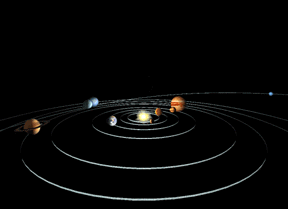
The Solar system is made of the Sun, 8 planets, and 5 dwarf planets, as well as their 174 known moons, asteroids, comets, dust,and gas.  Everything orbits around the Sun, our nearest star (except for the moons, which revolve around the planets).  Most things travel in an orbit, which is an elliptical shape for the planets.  Our solar system is close to the edge of the milky way galaxy.

The asteroid belt is what separates the inner planets from the outer planets.  You can see it in picture B.  It is full of space junk, leftover gases, and, of coarse, asteroids.  Ceres, a dwarf planet, is located in the asteroid belt and is 950 km wide.

The Kuiper belt is outside the solar system, a bit past Neptune's orbit.  This belt consists of spheres of ice and rock, with some as big as Pluto!  Pluto is actually located in the Kuiper belt.  See in picture C. 

You can read about the planets, the Sun, and more in my other posts!

Saturn

Basic Facts:
Moons:62

Period of Rotation: 10.67 hours

Period of Revolution: 29 1/2 years

Inner/Outer planet: Outer

Distance from Sun: 840 million miles

Atmospheric composition: hydrogen, helium, sulfur

Surface composition: ice and helium

Core composition: liquid metallic hydrogen

Diameter: 74,500 miles

Gravity: .92  x Earth's gravity

Discovered by: Galileo with use of a telescope in 1610

Tilt of Axis: 26 degrees

Planetary symbol:


Missions: Pioneer I and II, Voyager II, and Cassini

Saturn is the second largest planet in the solar system and is well known for it's rings.  Saturn, in Greek mythology is the son of Gaea and Neptune.  He gathered his brothers and sisters to form the titans. Saturn ( or Cronus) was leader of the titans, I believe.

Jupiter

Basic Facts:
Moons: 63

Period of Rotation: 9 hours and 48 minutes

Period of Revolution: 12 years

Inner/Outer planet: Outer

Terrestrial/gaseous planet: Gaseous

Distance from Sun: 460 million miles (741 million kilometers)

Atmospheric composition: 90% hydrogen and 10% helium

Core composition: liquid metallic hydrogen

Maximum tempurature:

Minimum temperature:

Gravity: 2.64 x Earth's gravity

Tilt of axis: 3.1 degrees

Planetary symbol:


Missions: Pioneer II, Voyager I, Voyager II, and Galileo

Jupiter is most famous for it's feature, the Great Red Spot, which is a storm that has lasted for centuries and shows no sign of stopping.  The Great Red Spot is 24, 860 miles across.  Jupiter, in Roman mythology, is the god of the sky and the king of all the gods.  Jupiter has three, very thin rings that can only be seen when the planet passes over the Sun.  Jupiter is also the largest planet in the solar system.  It is so big, that all the other planets could fit in side of it, if it were hollow.

Wednesday, February 26, 2014

Sun

The Sun is a medium-sized star at the center of our solar system.  Scientists think that it is about halfway through it's 10 billion life cycle, so it has 5 billion years to go!  It has a couple of layers:

The first and innermost layer is the core, where nuclear fusion happens.  Nuclear fusion combines the elements hydrogen and helium to create solar energy, such as heat and sunlight.

The next layer is the radiation zone.  Particles of light carry the energy made in the core to the next layer, the convection zone.  The convection zone is the outermost layer of the Sun.  Gases in this layer rise and sink, cool and heat up, like convection currents in the Earth's mantle.

The Sun does not have a period of revolution, since all stars are stationary, but it does have a period of rotation which is 27 days.  The Sun makes up 99.8% of the solar system's mass.  Now I will talk about the layers of the Sun's atmosphere.

The first or innermost layer of the Sun's atmosphere is the photosphere.  It is the only layer of the Sun that is visible to the naked eye.  Since photo means light, it is the "light sphere".  It is so bright that it blocks out the other layers of the atmosphere.

The second layer of the Sun's atmosphere is the Chromosphere.  Since chromo means color this is the color sphere.  You can only see this layer during a solar eclipse.  It is like a red or orange line.

The last layer of the Sun's atmosphere is the corona.  This layer is so faint that it can only be seen during a total solar eclipse.  The gases from this layer reach really far into space and are called solar  wind.  Sometimes solar wind enters the Earth's atmosphere at the north and south poles and causes aurorae.  In the north pole it is called aurora borealis, and in the south pole it is aurora australis.

Now we will talk about some of the Sun's features.  Sunspots are areas of gas that are cooler than the gases around them, so they look darker.  They are always found in groups.

Another feature is prominence.  Prominence is a loop of gas connecting a group of sunspots.  Prominences can suddenly connect and form an eruption or explosion called a solar flare.  Solar flares can reach for hundreds of miles into space.  This is a picture of prominence.