Friday, March 7, 2014

Neptune

Basic Facts:
Moons: 13

Period of Rotation: 16 hours

Period of Revolution: 165 years

Inner/Outer planet: Outer

Terrestrial/gaseous planet: gaseous

Distance from Sun: 2.82 billion miles (4.54 billion km)

Atmospheric composition: hydrocarbons, hydrogen, helium

Core composition: methane ice?

Mass: 17.2 x Earth's mass

Diameter: 30,760 mi (49,493 km)

Temperature at cloud tops: -346 degrees F

Gravity: 1.12 x Earth's gravity

Discovered by: Galle and d'Arrest in 1846

Tilt of axis: 29 degrees

Planetary symbol:


Missions: Voyager II

Uranus has a Great Dark Spot similar to Jupiter's Great Red Spot.  Scientists think that the Great Dark Spot is a hole in the methane deck of Neptune's atmosphere,kinda like the hole on Earth's ozone layer.  Uranus is the smallest gaseous planet, and believe it or not, Triton, one of Neptune's moons, is colder than Neptune, and Neptune is REALLY cold.




Uranus

Basic Facts:
Moons:27

Period of Rotation: 17 hours and 14 minutes

Period of Revolution: 84 years

Inner/Outer planet: Outer

Terrestrial/gaseous planet: gaseous

Distance from Sun: 1.7 billion miles (2.7 billion km)

Atmospheric composition: 83% hydrogen, 15% helium, 2% methane

Core composition: methane ice?

Mass: 14.5 x Earth's mass

Diameter: 32,000 miles (51,488 km)

Temperature at cloud tops: -328 degrees F

Gravity: .89 x Earth's gravity

Discovered by: William Herschel in 1781

Tilt of axis: 98 degrees

Planetary symbol:


Missions: Voyager II

Uranus is 1 of 2 planets ( Venus is the other planet) that rotates in retrograde motion around it's axis.  Uranus has a set of 13, very faint rings.

Thursday, March 6, 2014

The Solar System

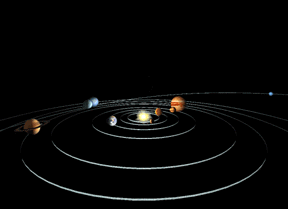
The Solar system is made of the Sun, 8 planets, and 5 dwarf planets, as well as their 174 known moons, asteroids, comets, dust,and gas.  Everything orbits around the Sun, our nearest star (except for the moons, which revolve around the planets).  Most things travel in an orbit, which is an elliptical shape for the planets.  Our solar system is close to the edge of the milky way galaxy.

The asteroid belt is what separates the inner planets from the outer planets.  You can see it in picture B.  It is full of space junk, leftover gases, and, of coarse, asteroids.  Ceres, a dwarf planet, is located in the asteroid belt and is 950 km wide.

The Kuiper belt is outside the solar system, a bit past Neptune's orbit.  This belt consists of spheres of ice and rock, with some as big as Pluto!  Pluto is actually located in the Kuiper belt.  See in picture C. 

You can read about the planets, the Sun, and more in my other posts!

Saturn

Basic Facts:
Moons:62

Period of Rotation: 10.67 hours

Period of Revolution: 29 1/2 years

Inner/Outer planet: Outer

Distance from Sun: 840 million miles

Atmospheric composition: hydrogen, helium, sulfur

Surface composition: ice and helium

Core composition: liquid metallic hydrogen

Diameter: 74,500 miles

Gravity: .92  x Earth's gravity

Discovered by: Galileo with use of a telescope in 1610

Tilt of Axis: 26 degrees

Planetary symbol:


Missions: Pioneer I and II, Voyager II, and Cassini

Saturn is the second largest planet in the solar system and is well known for it's rings.  Saturn, in Greek mythology is the son of Gaea and Neptune.  He gathered his brothers and sisters to form the titans. Saturn ( or Cronus) was leader of the titans, I believe.

Jupiter

Basic Facts:
Moons: 63

Period of Rotation: 9 hours and 48 minutes

Period of Revolution: 12 years

Inner/Outer planet: Outer

Terrestrial/gaseous planet: Gaseous

Distance from Sun: 460 million miles (741 million kilometers)

Atmospheric composition: 90% hydrogen and 10% helium

Core composition: liquid metallic hydrogen

Maximum tempurature:

Minimum temperature:

Gravity: 2.64 x Earth's gravity

Tilt of axis: 3.1 degrees

Planetary symbol:


Missions: Pioneer II, Voyager I, Voyager II, and Galileo

Jupiter is most famous for it's feature, the Great Red Spot, which is a storm that has lasted for centuries and shows no sign of stopping.  The Great Red Spot is 24, 860 miles across.  Jupiter, in Roman mythology, is the god of the sky and the king of all the gods.  Jupiter has three, very thin rings that can only be seen when the planet passes over the Sun.  Jupiter is also the largest planet in the solar system.  It is so big, that all the other planets could fit in side of it, if it were hollow.